For years, SEO has drilled one idea into our heads:
No search volume = not worth targeting.
So what did most of us do?
We opened tools like Ahrefs or Semrush…
Filtered out anything below 100 searches…
And ignored the rest.
It felt smart. Efficient, even.
But here’s the truth:
that habit quietly killed a lot of easy wins.
Now fast forward to 2026.
Search isn’t what it used to be.
People don’t just type short keywords anymore. They ask full questions. They use voice search. AI tools rewrite queries on the fly. Results are more personalized than ever.
And because of that?
Search volume has become… blurry.
Sometimes misleading. Sometimes completely wrong.
The bloggers winning today aren’t chasing the biggest keywords.
They’re doing something different.
They’re paying attention to the small, specific, often ignored queries—the ones tools call “zero volume.”
The ones everyone else skips.
In this guide, we’ll break it all down:
No fluff. No theory overload. Just what works—right now.
What Exactly Are Zero Volume Keywords?
Before we jump into the how, let’s get clear on one thing:
what does “zero volume” actually mean?
When an SEO tool shows a keyword has 0 searches per month, it doesn’t mean no one is searching for it. It simply means the tool doesn’t have enough data to estimate the volume with confidence.
In other words, “zero” often means unknown, not nonexistent.
The Real Problem: Data Lag
SEO tools like Ahrefs and Semrush are powerful, but they don’t work in real time. They rely on clickstream data, historical patterns, and aggregated estimates to calculate search volume.
Because of that, there’s always a delay—and sometimes it’s a big one.
Let’s say a new WordPress plugin launches today. Almost immediately, people will start searching for things like “how to fix [plugin name] login error” or “[plugin name] not working.”
But here’s the catch.
That keyword might show zero volume for months. By the time the tool updates and shows “100 searches,” competitors have already stepped in and taken those rankings.
The Rise of Ultra-Specific Searches
Search behavior has changed a lot over the past few years. People are no longer typing broad keywords and hoping for the best.
They’re searching with intent.
Instead of something like “best laptops,” a user today might search:
“best lightweight laptops for video editing under 80,000 INR in 2026.”
That’s a long, detailed, highly specific query—and that’s exactly the point.
Because these searches are so niche, SEO tools often label them as zero volume. But clearly, someone is searching for them—and usually, it’s someone who knows exactly what they want.
Key idea to remember:
Zero volume doesn’t mean zero traffic.
It usually means untapped opportunity.
Why 2026 is the Year of Zero Volume SEO
At this point, you might be thinking:
Is it really worth writing a 2,000-word post for something that might bring just 10 visits a month?
Fair question.
But here’s the thing—those 10 visits can be far more valuable than 1,000 random ones.
Let’s break down why this strategy works so well in 2026.
1. The Conversion Powerhouse
High-volume keywords are usually top-of-funnel. Someone searching for “blogging tips” is just exploring, not ready to take action.
Zero volume keywords are different. They usually come from users with a specific problem and clear intent.
For example, someone searching:
“how to fix GeneratePress mobile menu not showing”
isn’t browsing—they’re stuck and need a solution right now.
When your content solves that problem, trust builds instantly. And that trust directly impacts conversions.
These users are far more likely to:
Less traffic, yes—but much higher intent.
2. Building Topical Authority (E-E-A-T)
Google in 2026 looks beyond individual posts. It evaluates how deeply a site covers a topic.
If content only targets broad keywords, the site feels surface-level. But when content consistently covers specific, niche queries, it signals real expertise.
Think of it like this.
Instead of writing just one article on WordPress speed optimization, you build a cluster of highly targeted posts that cover real issues users face.
For example:
Each topic might look small on its own. But together, they create a strong topical footprint.
That’s how authority is built.
And when you later publish a competitive “money post,” Google already trusts your site—making it easier to rank.
3. Beating the AI Overviews
AI Overviews have changed how people interact with search results.
For broad queries like “What is SEO?”, users often get their answer directly on the results page. No clicks, no traffic.
That’s where most content loses.
But zero volume keywords play a different game.
They focus on areas where AI still struggles—like specific problems, new tools, and real-world use cases. These are situations where users need more than a generic summary.
Content targeting these queries naturally stands out because it:
So instead of competing with AI on general topics, you move into spaces where depth and experience matter more than summaries.
How to Find “Hidden” Keywords (That Tools Miss)

If SEO tools can’t show you zero-volume keywords, where do you find them?
Simple.
You go where real people are asking real questions.
Because that’s where these keywords actually live.
1. Google Search Console: Your Personal Goldmine
This is easily one of the most underrated methods.
Open your Google Search Console and head to the Performance report. Then look for queries that are getting impressions but very few clicks.
That’s where things get interesting.
Sometimes, you’ll notice your site is already showing up for long, specific queries—even if you never targeted them. Maybe you’re sitting on page 3 or 4 for a keyword you didn’t even know existed.
That’s not random.
It’s a signal.
If Google is already testing your page for that query, it means there’s demand. Now imagine what happens when you create a dedicated, optimized post for it.
2. The Reddit & Quora Goldmine
When Google doesn’t give clear answers, people turn to forums.
That’s why platforms like Reddit and Quora are packed with zero-volume opportunities. These are real questions from real users—often very specific, and often unanswered properly.
Start by exploring communities in your niche, like blogging or WordPress-related forums. Then pay attention to the types of questions people ask repeatedly.
Look for patterns like:
And especially notice when multiple people reply with “I have the same issue.”
That’s your cue.
It means the problem is common—but content around it is missing or weak. That’s exactly where you step in.
3. Google Autocomplete & “People Also Ask”
Google itself is a goldmine—you just need to use it differently.
Start typing your main keyword into the search bar and pause. Don’t hit enter. The suggestions that appear are based on real searches happening right now.
These aren’t random.
They’re driven by actual user behavior.
Then, once you search, check the “People Also Ask” section. These questions are often more detailed and specific than the main keyword.
If you can answer those questions better—more clearly, more directly—you have a strong chance of capturing that traffic.
4. Customer Questions & Real Conversations
Sometimes, the best keywords don’t come from tools or platforms.
They come from real conversations.
If someone asks you a specific question—whether it’s a client, reader, or even a comment on your blog—that’s a keyword opportunity.
For example:
These are not just random questions.
They’re high-intent queries that others are likely searching for too—but no tool is tracking them properly yet.
Stop relying only on tools.
Start listening to people.
That’s where the real opportunities are hiding.
Strategy Check: Identifying “Good” Zero Volume Keywords
Not every zero-volume keyword is worth targeting.
Some are hidden opportunities. Others are just… dead ends.
So before jumping in, you need a quick way to tell the difference between a high-value keyword and one that’s simply not worth your time.
Ghost Keyword vs Dead Keyword
A good zero-volume keyword usually shows strong intent, relevance, and potential. A bad one lacks direction and won’t bring meaningful traffic—no matter how well you rank.
Here’s a simple way to spot the difference:
| Feature | Ghost Keyword (Target These) | Dead Keyword (Avoid These) |
|---|---|---|
| Intent | Clear problem or “how-to” query | Random or unclear phrasing |
| Trend | New or growing topic | Outdated or obsolete topic |
| Relevance | Closely tied to your niche or offers | Completely unrelated to your content |
| Competition | Weak results (forums, outdated posts) | Strong, well-optimized authority pages |
How to Think About It
Before choosing a keyword, ask a simple question:
“Is this solving a real problem for the right audience?”
If the answer is yes—and the competition looks weak—you’re likely looking at a ghost keyword.
If not, it’s probably something to skip.
That small filter can save hours of writing…
and help you focus only on keywords that actually move the needle.
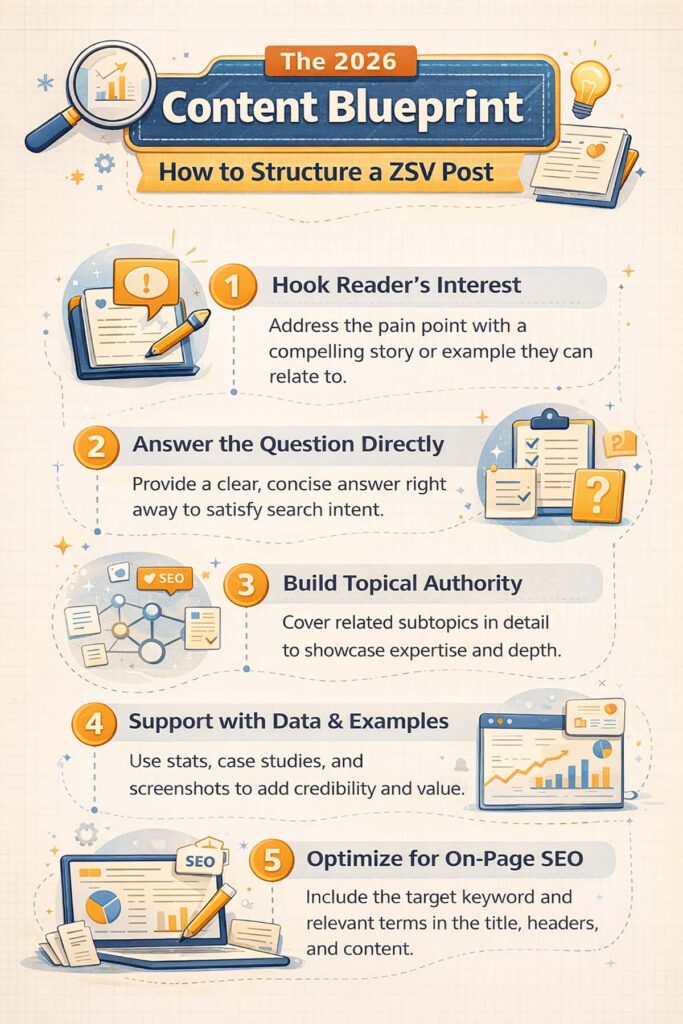
The 2026 Content Blueprint: How to Structure a ZSV Post
When targeting a zero-volume keyword, the goal isn’t just to write an article.
It’s to build a solution hub.
Because competition is low, rankings don’t depend on backlinks as much. What really matters is how clearly and completely the content solves the problem.
Structure wins here.
1. The “Immediate Answer” (The Featured Snippet Play)
In 2026, users don’t want to scroll—they want answers fast.
That’s why the first 100 words of the post matter more than ever. You need to address the query directly and clearly right at the start.
For example, if the keyword is:
“How to fix W3 Total Cache minify error on Bluehost”
Don’t build up slowly.
Start with the answer.
To fix the W3 Total Cache minify error on Bluehost, go to [X setting] and disable [Y feature], as it conflicts with Bluehost’s server configuration.
Simple. Direct. Useful.
This not only helps readers—it also increases your chances of getting picked for featured snippets and AI summaries.
2. The Inverted Pyramid Approach
Once the answer is clear, the rest of the post should expand logically.
Think of it like a funnel—starting broad, then going deeper into details and edge cases.
A strong ZSV post usually follows this structure:
This approach keeps the content focused while still being comprehensive.
It also signals to Google that the page is not just answering the question—but fully covering it.
3. Optimizing for AI Overviews
AI-driven search is now a big part of how content gets discovered.
And AI prefers content that is structured, clear, and easy to extract.
One simple way to improve visibility is by turning your headings into questions.
Instead of writing something vague like:
“Plugin Settings”
Write something like:
“Which settings in [Plugin Name] cause the most conflicts?”
This does two things:
At the end of the day, the goal is simple:
Don’t just write content.
Build the best possible answer on the internet for that query.
Semantic SEO: Building Topical Authority

In 2026, Google doesn’t just look for your main keyword.
It looks for context.
More specifically, it looks for entities—related concepts, terms, and connections that show you truly understand the topic, not just targeting a single phrase.
That’s what separates thin content from real authority.
The Cluster Strategy
When you publish a zero-volume post, don’t treat it like a standalone article.
Treat it as part of a bigger system.
For example, if you write about a specific WordPress error, that post should connect to other relevant content across your site. Over time, this builds a strong topical network that Google can easily understand.
A simple structure looks like this:
Individually, each post might seem small.
But together, they form a content web.
And when Google sees that your site covers a topic from multiple angles—especially detailed, niche ones—it starts to trust your expertise.
That’s how topical authority is built.
And once that trust is established, ranking for competitive keywords becomes much easier.
Natural Keyword Variations
Keyword stuffing is outdated.
In 2026, it’s all about keyword variety and natural language.
Instead of repeating the same phrase again and again, focus on using related terms that fit naturally within the content. This helps both readers and search engines understand the full scope of your topic.
For example, if your main topic is zero volume keywords, you can naturally include variations like:
These variations don’t just improve SEO—they make your writing feel more natural and complete.
The goal here is simple:
Don’t optimize for a keyword.
Optimize for a topic.
That’s what wins in modern SEO.
The “Zero-Click” Optimization Strategy
One of the biggest challenges in 2026 is the rise of zero-click searches.
That’s when users get their answer directly on Google—through featured snippets or AI Overviews—and never visit your site.
Sounds scary.
But it doesn’t mean you can’t win.
You just need to change the way you deliver value.
The Idea: Layered Value
Instead of hiding the answer, you give it upfront.
But you don’t stop there.
You layer the value so that users still have a reason to click through and stay on your page.
Think of it like this:
For example, your intro can solve the problem in a few lines. But inside the post, you go deeper with step-by-step instructions, examples, and practical insights.
That’s something AI summaries can’t fully replace.
Use Personal Experience
AI is great at summarizing information.
But it can’t replicate your experience.
That’s your edge.
Instead of just explaining what works, show what you tested, what failed, and what actually made a difference. This adds a layer of credibility that generic content simply can’t match.
You can naturally include lines like:
These small additions make your content feel real—and more trustworthy.
Add Human Elements
This is where most content falls flat.
To stand out, your post needs to feel human, not just informative.
That means going beyond clean explanations and adding real-world context:
These details build trust.
And trust is what keeps readers on your page—even when Google already gave them a quick answer.
At the end of the day, you can’t stop zero-click searches.
But you can make sure that when someone does click…
your content is worth it.
Scaling: How to Manage Hundreds of Small Posts
There’s one downside to the zero-volume strategy.
You need volume of content to see big results.
You can’t rely on one or two posts to bring in massive traffic. Instead, growth comes from publishing many small, targeted posts that work together over time.
That sounds like a lot of work.
But with the right system, it becomes manageable.
The Template Approach
When you’re creating dozens (or hundreds) of ZSV posts, consistency matters more than perfection.
That’s where a simple template helps.
Instead of starting from scratch every time, you follow a repeatable structure that keeps your content clear, complete, and fast to produce.
A solid ZSV template looks like this:
This kind of structure does two things.
It speeds up your writing process—and ensures every post delivers real value without overthinking it.
Repurposing for Social Media
The best part about zero-volume content?
It’s based on real problems.
And that makes it perfect for repurposing.
Instead of letting a post sit on your blog, you can turn it into multiple content formats and reach a wider audience.
For example:
You’re not creating new content—you’re just repackaging the same solution.
That’s how you scale this strategy:
Create once.
Distribute everywhere.
Repeat consistently.
Measuring Success: The Metrics That Matter

If you judge zero-volume SEO using traditional metrics, it might look like it’s not working.
Low traffic. Few impressions. Slow growth.
But that’s the wrong lens.
With this strategy, success isn’t about how many people visit your site—it’s about what those people do once they arrive.
So instead of focusing on vanity metrics, you need to shift your KPI dashboard toward intent-driven performance.
Traditional Metrics vs ZSV Metrics
Here’s how that shift looks in practice:
| Traditional Metric | 2026 ZSV Metric | Why It Matters |
|---|---|---|
| Total Traffic | Conversion Rate | 10 high-intent visitors are more valuable than 1,000 casual browsers |
| Keyword Rankings | Assisted Conversions | Did this post guide users toward your services or offers? |
| Time on Page | Scroll Depth | Are users actually reading and engaging with the solution? |
| Backlinks | Internal Link Clicks | Are users moving deeper into your content ecosystem? |
The Real Shift
This strategy rewards quality over quantity.
A post that gets 20 visitors but generates 2 conversions is far more valuable than one that gets 2,000 visitors and does nothing.
That’s the mindset shift most bloggers miss.
At the end of the day, don’t just ask:
“How much traffic did this post get?”
Ask:
“Did this post actually help—and did it lead somewhere meaningful?”
That’s what defines success in 2026.
Conclusion: The Future Belongs to the Specific
The “broad” era of the internet is fading.
In 2026, trying to be everything for everyone doesn’t work anymore. General content gets ignored—or worse, replaced by AI summaries.
What still works?
Specificity.
Zero-volume SEO isn’t just another tactic.
It’s a shift in how you think about content.
Instead of chasing big numbers, you focus on solving real problems for real people. You aim to be the most helpful resource for a very specific query—and you do it better than anyone else.
That’s how authority is built today.
A Simple Action Plan
If you want to put this into practice, start small.
Don’t overthink it.
Just solve the problem clearly and completely.
Over time, these small wins stack up.
Your content becomes more useful. Your site becomes more trusted. And your rankings start to follow.
SEO isn’t dead—it’s just evolving.
Less about algorithms.
More about people.
And the bloggers who understand that shift?
They’re the ones who will win.